You have to expose children to time travel ideas when they're young, before their minds are stuck in 3 dimensions, seeing time as being linear. When I visited a friend recently, I started immediately with this 5-year-old son.
5yrold: Who are you?
Me: I'm Robert.
5yrold: My little brother's name is Robert.
Me: I know, I'm him from the future.
5yrold: What?
Me: I've traveled through time to spend time with myself and my family when we were young.
He was skeptical at first, but I told him that when the first time travel machines came out in 2022 time travel was pretty expensive, so I didn't make my first trip until 2025. First I went back to see the dinosaurs, but it was hot and hard to breathe, so it wasn't as much fun as I thought it would be. Then I went to see Jesus speak, but I don't understand ancient Hebrew so I really didn't get much out of the experience. So when I had saved enough for a third trip I figured I'd go back and see what my parents were like when I was barely out of diapers. Plus, I explained that even though I was just a young child, I distinctly remembered being visited by myself from the future around this time, so since I was going to take this time travel trip anyway, I might as well take it now.
His parents are cool and played along. They called me "son" and I called them mom and dad. The 5-year-old was pretty skeptical about the whole thing, but it's pretty easy to outsmart a child when they try to expose your fibs. For example:
5yrold: Ok if you're from the future then you know if I'm about to cough.
Me: How would I know that? I'm not here - I'm in the next room.
5yrold: (calls his brother into the room). Robert, watch me carefully and remember if I cough.
Robert(not me): (Nods, watches carefully)
Me: I remember this conversation.
5yrold: So did I cough?
Me: I remember me from the future saying that you wouldn't, and then you coughing just to prove me wrong. So ... no.
5yrold: (thinking very hard) Cough.
Me: See?
Later on we were in the car driving home from somewhere and he really wanted to get home so he could play. The drive would take a half hour and he didn't want to wait. So I told him to just go forward in time to when we were home and he could play right now. Then, he could always come back and do the drive home later tonight. I explained that we don't have to experience the week in a linear order: Monday, Tuesday, Wednesday etc ... that time was all relative and that we could do Monday then Wednesday then back to Tuesday. He seemed to understand this.
After a short pause, I welcomed him back. He said he didn't go anywhere, and I said yes, he went to the future to play, and now he was back to do the drive home. When he said he didn't remember playing, I said that's because it's the drive home now, so he doesn't have the memories of having played yet. Memories are stored in the brain, so if he wants to remember playing, he needs to go forward to and experience a time when those memories existed. But I assured him that he has, in fact, already played, eaten dinner, and gotten into bed.
Anyway I'm not sure how much sense any of this makes to him, but I've got him thinking about time in non-linear terms, so he may one day be the guy to invent time travel.

Tuesday, July 21, 2009

Sunday, July 5, 2009
Free Time Travel Concept Album
Click HERE and download for free a concept album by an artist who performs under the name Fakesensations. The album is called Isaac And the Secret Chord and is actually really good. That link will allow you to download all the tracks but two. Those two are not essential to the story but can be purchased at iTunes in case you want the story a little more fleshed out.
I liked the album much more than I thought I would and I am actually very excited about the story it tells. Here is what I understand of the story (though it could be I understood some of it wrong)...
George is a physicist who has discovered a means of time travel (a secret chord played on a special guitar – he discovers this chord after listening to Leonard Cohen’s album, Various Positions) and has gone back in time to the 1966 to visit a woman he once loved named Sylvie – who I believe had died (though maybe she had just left him?).
Isaac is his son in the present. Isaac goes through his dad’s notebooks and learns about the chord. He goes back and finds his dad with Sylvie. He urges George to come back, but George doesn’t want to go back. He has chosen to trade that timeline as it was for a chance at a life with Sylvie.
Then we discover that the reason Sylvie and George had ended in the original timeline is because Professor Rex (George’s old lab partner who did not want Sylvie and George’s relationship interfering with their work) had shown up at her door one night after George left. But now because the timeline had been changed, Professor Rex ends up abducting Isaac to learn the secret means of time travel.
The story ends with Isaac “stranded in time” by Professor Rex who has sent him into the distant future. And Sylvie saying that we need to find Professor Rex.
Listen to it. I'd love to hear what you think.
An Interesting Idea From The Outer Limits
The new (1995-2002) Outer Limits has collected all of the time travel episodes (6) onto one DVD collection called Time Travel and Infinity Collection. It is always super cheap at Amazon. Right now you can pick it up for just a couple bucks. It's not the nest thing ever, but it has some interesting ideas.
One of the stories is called A Stitch In Time and shows time travel in a single, changeable timeline. The time traveler in the story goes back in time and kills serial killers before they can begin their killing spree. She is driven mad because every time she returns, she remembers the original timeline and also has memories of the "new" (changed) timeline and the events which occured as a result of each change.
She explains: "The time traveler remembers not only the changed timeline, but the original one as well. Every time I use the technique, another universe of possibilities slams into my head."
Saturday, July 4, 2009
The Time Travel Fund (TM)
THIS organization will take your money.
The idea is they will invest it for you and keep a record of your name. Then in the future when time travel is possible (assuming I suppose that it is not currently possible), they will pay the time travelers to come get you and take you to the future with them.
They explain: "We establish a fund in current time. You make a small contribution to the fund, and in a few hundred years that small amount grows to a very large amount. From that fund, moneys will be taken and used to retrieve you, perhaps seconds after you join, perhaps even moments before your recorded death, perhaps some other point in your lifetime."
Anyway, check out the webpage and decide for yourself if you are willing to invest in the Time Travel Fund (TM). That page should answer all your questions. Questions such as "are there any restrictions?", and "what if they outlaw time travel?" (interesting question), and "is this a joke, scam or cult?"
It's an interesting idea.
Thursday, June 25, 2009
Time Travel In Comics: Fantastic Four
Fantastic Four: A Death In The Family - is a one shot issue put out in 2006. Written by Karl Kesel and drawn by Lee Weeks.
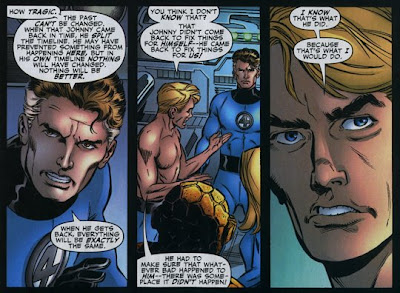 I think Reed in the first panel gives a pretty good explanation of Branch Theory in case you are still trying to understand the idea of diverging timelines. I also love Johnny's defense.
I don't want to spoil it, because you should go buy this issue, but looking at the title of the book I am sure you can guess what happened. And then after it happened, Johnny goes back in time to change the past and prevent it. After preventing it, we learn that this is an example of Branch Theory and that an alternate timeline was created as a result of his traveling back...
 I think Reed in the first panel gives a pretty good explanation of Branch Theory in case you are still trying to understand the idea of diverging timelines. I also love Johnny's defense.
Wednesday, June 24, 2009
"Hear Everything Forever"
HERE's another cool link that my friend, GST sent me. It's a podcast that talks about Guglielmo Marconi and Italian inventor and his idea about a machine that GST described to me as "like the Chronovisor, but an audio version." You can listen to it, or I transcribed some of it here...
He would tell people if he got it right he could hear Jesus of Nazereth giving the Sermon on the Mount. But he would be able to hear everything ever said. Everything he ever said. At the end of his life he could sit in his piazza in Rome and hear everything that was ever said to him or about him. He could relive every toast and testimonial. And we all could. Hear everything. Hear Caesar, hear Shakespeare give an actor a line reading, hear my grandmother introduce herself to my grandfather in a night club in Rhode Island, hear someone tell you that they love you that first time they told you they love you.
Hear everything. Forever. "
I love it.
Relativity
Einstein suggested that time is relative:
“Put your hand on a hot stove for a minute, and it feels like an hour. Sit with a pretty girl for an hour and it feels like a minute.”
HERE is a guy who in 2005 tested out Time Dilation. It's pretty cool if you're the kind of nerd who is really into time travel (I am).
Thanks to GST for sharing the link with me.
Saturday, June 6, 2009
What qualifies as time travel?
If I implanted you with memories of the future, convincing you that it was the year 2030, and in those memories, giving you a time machine to travel back to 2009, and then woke you up with your memories intact, you would think you had travelled in time, even though you had never left the year 2009.
But what would be the difference? If you actually were in the year 2030 and actually did travel back in 2009, you'd be in the same situation: walking around the year 2009 with memories of the next 21 years.
That would also be a great way to get you to do something. I could convince you to assassinate someone because I gave you the memories that your target would go on to do something really awful.
In a way, this is time travel. Even though it really isn't.
Tuesday, June 2, 2009
The Chronovisor
The 2006 film, Déjà Vu featured a machine that allowed people in the present to view events in the past. The machine utilizes a wormhole and has a restrictive range of what you can view (it goes back exactly 4 days, 6 hours, 3 minutes, 45 seconds). This is one of my favorite time travel movies and I was especially excited about the concept of the technological window to the past.
As it turns out, it is not a new concept and in fact might not be entirely fictitious…
In the 1950’s twelve world famous scientists allegedly developed a machine called the Chronovisor. The Chronovisor was described by one of the scientists, Father (yes, he was also a priest) Ernetti as a large cabinet with a cathode ray tube and a series of buttons. With the buttons one could select a specific time and location and through the tube, one could view (and hear) the past.
The development and construction of the Chronovisor was kept a secret, until Father Ernetti told his story to the author Francois Brune (another priest) in the early 60s. According to Ernetti, his machine worked by decoding and reproducing the electromagnetic radiation left behind from past events.
Ernetti claimed to have used the Chonovisor to view and photograph the crucifixion of Christ and also to witness and transcribe partions of a play called Thyestes by the Latin playwrite, Quintus Ennius.
Although there is no physical proof of the Chronovisor’s existence, it is believed that the Roman Catholic Church seized the machine and currently has it hidden at the Vatican.
This is not the only (or even the first) claim of a working time window. Many scientists have claimed to have created time viewing devices and you can read about many of them HERE.
Further reading:
http://www.unmuseum.org/
http://www.theepochtimes.com/
http://keelynet.com/interact/
http://www.absoluteastronomy.
If you had access to the Chronovisor, what past events would you like to view/hear the most?
Monday, June 1, 2009
Spacetime Foam (With Star Trek Examples From A Brilliant Physicist)
Dr. Machio Kaku speaking at the New York Academy of Sciences about his book, Physics of the Impossible…
“At the tiniest subatomic level, the fabric of space and time becomes so unstable that it starts to behave like a foam. Its surface alive with tiny bubbles momentarily popping in and out of existence. We call this quantum state the spacetime foam. It’s thought that contained within this foam, are objects called wormholes – tiny passage ways between two points in space and time.
The secret to building a time machine is to stabilize the spacetime foam long enough to make one of these worm holes permanent. And the way we do that is by subjecting it to enormous amounts of energy.”
What kind of energy is required and what type of civilization could harness the energy and technology required to find and manipulate wormholes from the spacefoam? I already quoted Dr Kaku’s breakdown HERE. But here it is again – this time with his Star Trek examples:
“When we look in outer space, we physicists don’t see little green men, we see type one, type two, and type three civilizations in outer space.
A type one civiliazation is a Planetary civilization: They control the energy of an entire planet; they control the weather; they control volcanos; earthquakes. (this is where we will be) about a hundred years in the future.
Type two is Steller. They control the energy of an entire star. They are perhaps a few thousand years ahead of us. And the Federation of Planets, Star Trek, is a typical type two civilization.
Then we have type three: A Galactic civilization. These civilizations can eat type two civilizations for breakfast. They control the energy of an entire galaxy. (Our becoming a type three civilization is) hundreds of thousands of years into the future. (They are) like the Borg in Star Trek
…A type three civilization may begin to think about building a time machine. They can build atom smashers of galactic size to open gateways in the spacetime foam.”
Saturday, May 30, 2009
John Titor
You may already know the story of John Titor, but if you do, then why didn’t you tell me about it???
He was a soldier from the future who was sent back in time to 1975 to retrieve an IBM 5100 computer which was needed to debug various legacy computer programs in 2036 (his time of origin).
He started posting frequently on internet message boards starting in the year 2000. He said he was on a temporary stopover in our time to collect pictures lost in the (future) civil war and to spend time with his parents. He was posting on the boards, not to convince anyone he was a genuine time-traveler, but just to gauge people's responses to meeting someone from their future. On these message boards, he answered questions and posted about our future (his past). He also described his own time machine and explained the nature of time travel (Branch Theory).
In 2001, Titor went back to his own timeline and was never heard from again.
There is a book discussing his claims, called John Titor: A Time Traveler's Tale. But apparently it is really rare and super expensive, so if you see it for cheap in a used bookstore buy it for me please.
Anyway, at first I had my doubts, but after reading his posts, I am not entirely sure. If it is a hoax, then he is brilliant and definitely knows what he's talking about. I recommend you read it, because either way, it is really interesting:
Read Archive
Anyway, at first I had my doubts, but after reading his posts, I am not entirely sure. If it is a hoax, then he is brilliant and definitely knows what he's talking about. I recommend you read it, because either way, it is really interesting:
Read Archive
Thursday, May 28, 2009
Time Travel In Comics: Cable
Over the last year and a half one of my favorite comic books has been Cable (written by Duane Swierczynski) and the storyline has been very much centered around time travel.
To give a quick background, there was a mutant baby born who is supposed to be the hope for mutant kind – and Cable has been put in charge of protecting her...
 Now Bishop (who comes from the future) recognizes that the baby girl as the mutant who will ultimately be responsible for the deaths of millions and the fact that in his time, mutants were kept in concentration camps. Therefore, he wants nothing more than to kill the baby – which would change his timeline and prevent himself and his family from suffering the way they will in the future/ the way they did in his past.
 So in order to protect the baby, Cable jumps into the future with her. Bishop gets a hold of a time-traveling device and follows them. Cable’s time traveling device gets broken in a battle and will now only allow him to go forward.
So since Bishop is having a hard time finding Cable and the baby, he starts to make a trap for them. He goes forward in time and destroys certain places – for example, he destroys Australia, therefore he knows that Cable and the baby won’t be in Australia after that. And by destroying enough places, he can eventually narrow down where they actually can go in the future. And so the chase goes on from there with Cable and the baby jumping further and further into the future – with Bishop right behind them.
It’s great because we the readers are left trying to decide if Bishop is the bad guy or not. Because he IS trying to kill a baby, which of course is bad – but knowing what he knows the baby will eventually become and how she will change the world for the worse, you start to feel he is pretty justified in doing it.
So I find myself not knowing who to route for and just waiting for each next issue to come out to find out what is going to happen next.
I was not really a fan of either Cable or Bishop, but after reading this story, they are now both two of my favorite characters in the Marvel Universe. I highly recommend you buy this story. The first hardcover collection, Cable, Vol. 1: Messiah War is out right now, the second hardcover collection Cable Vol. 2: Waiting for The End of the World comes out in June, and the third Cable Vol. 3: X-Men, Cable, & Bishop comes out in July.
To give a quick background, there was a mutant baby born who is supposed to be the hope for mutant kind – and Cable has been put in charge of protecting her...
Now Bishop (who comes from the future) recognizes that the baby girl as the mutant who will ultimately be responsible for the deaths of millions and the fact that in his time, mutants were kept in concentration camps. Therefore, he wants nothing more than to kill the baby – which would change his timeline and prevent himself and his family from suffering the way they will in the future/ the way they did in his past.So in order to protect the baby, Cable jumps into the future with her. Bishop gets a hold of a time-traveling device and follows them. Cable’s time traveling device gets broken in a battle and will now only allow him to go forward.So since Bishop is having a hard time finding Cable and the baby, he starts to make a trap for them. He goes forward in time and destroys certain places – for example, he destroys Australia, therefore he knows that Cable and the baby won’t be in Australia after that. And by destroying enough places, he can eventually narrow down where they actually can go in the future. And so the chase goes on from there with Cable and the baby jumping further and further into the future – with Bishop right behind them.
It’s great because we the readers are left trying to decide if Bishop is the bad guy or not. Because he IS trying to kill a baby, which of course is bad – but knowing what he knows the baby will eventually become and how she will change the world for the worse, you start to feel he is pretty justified in doing it.
So I find myself not knowing who to route for and just waiting for each next issue to come out to find out what is going to happen next.
I was not really a fan of either Cable or Bishop, but after reading this story, they are now both two of my favorite characters in the Marvel Universe. I highly recommend you buy this story. The first hardcover collection, Cable, Vol. 1: Messiah War is out right now, the second hardcover collection Cable Vol. 2: Waiting for The End of the World comes out in June, and the third Cable Vol. 3: X-Men, Cable, & Bishop comes out in July.
Wednesday, May 13, 2009
Star Trek Movie Time Travel
WARNING: SPOILERS
I thought it was great, but I just wanted to briefly discuss the time travel aspects of the movie.
Basically the beginning of the movie is the beginning of a diverging timeline (branch theory). So in fact, this is not a reboot of the franchise, but just a completely new timeline (created when Nero came back in time and altered when he destroyed the Enterprise and killed Kirk’s dad) that runs parallel to the timeline that the original series and movies took place.
I like how they played it with old man Spock remembering events as they occurred in his timeline and how they actually unfold differently in this new universe. And because they went with a parallel timeline, they were able to avoid creating any complicated paradoxes.
Your thoughts?
Friday, April 24, 2009
Speaking of Hitler
I hope the authors of the following strips don't sue.

 There are also two awesome links I found that talk about why you can't kill Hitler, and Hitler's Time Travel Exemption Act.

 There are also two awesome links I found that talk about why you can't kill Hitler, and Hitler's Time Travel Exemption Act.
Killing Hitler - The Time Travel Cliche
No time travel blog can be complete without a discussion on killing Hitler. Yep, you just go back in time to before Hitler's rise to power, kill him, and prevent the Holocaust – it looks good on paper, but I wonder if it would really be as easy as it sounds.
First we will assume your means of travel will allow you to take back clothing and other physical items. If not, keep in mind how much more difficult this would be…
Now if you don't want to call attention to yourself - and you probably don't, you had better go back in clothing of that period. So you'll want to start out by researching and getting that all ready.
And if you are going to get to Austria/Germany and then get to Hitler, you're going to need some cash. So second, you will have to get ahold of both US dollars and Deutch Marks - from that time period. And make sure it's in good enough condition so they'll accept it when you get there. I am not sure how difficult this would be, but I suspect it might be particularly difficult. And keep in mind how weak the German economy was during that time, so make sure you take plenty.
Do you speak German? You'll probably need to speak German if you are going to be looking for a man no one has heard of in Austria at the turn of the century. So third, learn German.
Now, if your means of time travel doesn't deliver you right to the Hitler family doorstep, you're going to need to make your way to the coast and get aboard a ship headed for Germany. So make sure when you pick the time destination, you are giving yourself enough time to make that journey (because if he does start to gain political power before you get to him, it is going to be that much more difficult for a foreigner such as yourself to get very close to him). And we'll just hope you arrive in Germany healthy and in one piece.
Now you are in Germany, all you have to do is find him. You've done your research, you know generally where he'll be, so finding him may or may not be that difficult. Although the fact that you are a stranger in a foreign land and time, may make it a little bit more so.
So yeah, those are just a couple thoughts. I just think that when you consider the actual logistics (and there's probably plenty that I haven't thought of) of killing Hitler, it's probably not as simple as it seems at first thought. In fact I suspect it would be more of a dedication of years and years of your life – if not your entire life.
But I guess it's probably worth it, right? Unless the unforeseen events that occurred in his absence were an even worse fate.
Also be careful going around killing babies, because maybe when you come back to your present, there will be a new name for evil personified – yours.
Wednesday, April 22, 2009
Lucky Charms - False Advertising
I have never been so excited to buy a box of cereal in my life...
 And I have also never been so disappointed by a box of cereal in my life.
Friday, April 17, 2009
Blog of the Year
This blog may not appear that popular now, but it's going to win "Blog of the Year" in 1968.
It's actually going to be huge with people in the '60s, but unfortunately not until after the writers have passed on.
It's actually going to be huge with people in the '60s, but unfortunately not until after the writers have passed on.
Wednesday, April 15, 2009
Lost, Time Travel, and Creating Something from Nothing
The current season of the popular American television series Lost has been largely based around time travel. Several characters have traveled from our era (the first decade of the 2000s) to 1977. The show seems to be going with the "Granhttp://www.blogger.com/img/blank.gifdfather Paradox" theory of time travel: that the past cannot be changed. ( to read about the Gradfather Paradox vs. Branch Theory)
Here's a conversation where the character Miles tries to explain this to Hurley.
So, we'll assume that this is the way time travel works on Lost. There is a single timeline, and the actions taken by the time travelers in 1977 will in no way change the reality that they know in the 2000s.
So, in tonight's episode Hurley was seen writing in a notebook, and admitted to Miles that he was working on the screenplay to the Empire Strikes Back. To paraphrase:
"I've seen Empire Strikes Back like 200 times. It's 1977 right now and Star Wars just came out, so I figured I'd just write the script and send it to George Lucas to save him the trouble."
The show used Empire Strikes Back as a metaphor for Father-Son relationships, but let's look at Hurley's idea a little deeper.
What if he's successful? He manages to write the entire screenplay and get it to George Lucas. Lucas (along with credited screenwriters Lawrence Kasdan and Leigh Bracket) pass it off as their own work and make the film. If this happens...
THEN WHO THE HELL WROTE EMPIRE STRIKES BACK???
Hurley didn't write it, he was simply transcribing a film that he knew from memory. But George Lucas didn't write it either, he just used a screenplay that arrived in a mysterious package in 1977. If George Lucas hadn't made the film, Hurley wouldn't have been able to write it. But if Hurley hadn't written it, the second film in the Star Wars series wouldn't have been the same movie that we all know and love.
Assuming a single timeline, and assuming that Hurley was successful, then the script for Empire Strikes Back has no origin. Essentially, it created itself!
So what does this mean? Well, that's what we need to think about. Discuss.
Funny Time Travel Discussion
Me: As soon as it's invented, I'm going to travel back in time.
Buddy: Time travel is theoretically impossible.
Me: It is?
Buddy: Sure. Haven't you heard of the grandfather paradox?
Me: No, what's that?
Buddy: What happens if you travel back in time and kill your grandfather?
Me: What?
Buddy: What happens if you kill your grandfather, you know, before your father is born and therefore before you're born.
Me: Why would I do that?
Buddy: See, if you were never born, then you couldn't kill your grandfather, which would be a paradox.
Me: What do you have against my grandfather?
Buddy: You're missing the point.
Me: What's your point? That people who hate their grandfathers can't travel through time?
Buddy: No, nobody can travel in time.
Me: Even people who have no intention of killing their grandfather?
Buddy: Right.
Me: That doesn't make any sense.
Buddy: Okay, forget about your grandfather. Let me think of a way to put this in terms you'll understand. Remember Back to the Future?
Me: Yeah, that was a great movie. I went out and bought an orange vest just like Marty McFly.
Buddy: Remember how he accidentally caused his parents never to meet?
Me: But the orange vest never really caught on.
Buddy: You're not listening. Remember how he had a picture where he started to fade away? And how he had to get his parents to meet and fall in love before he disappeared?
Me: Yeah, that was a great movie.
Buddy: Well if his parents never met, and he disappeared, then how could he travel back to stop them from meeting in the first place? That's a temporal paradox!
Me: Haha - and Biff wound up covered in manure!
Buddy: Are you listening?
Me: Yes. I'll steer clear of my mother and be nice to my grandfather.
Buddy: You're still not getting it. Look, what if you went back in time and, I don't know ... killed Hitler.
Me: Hey that's a good idea.
Buddy: Ok let's say you killed Hitler and so the Nazis and the Holocaust and World War II never happened.
Me: Right.
Buddy: Ok if those things never happened, then you would have no reason to go back and kill Hitler.
Me: Even if he was my grandfather?
Buddy: What?
Me: That's probably why Hitler never had kids. So no one could travel back in time and kill him.
Buddy: I give up.
Me: I'm glad we had this conversation. I'll make sure to leave Hitler alone.
Me: Hey where are you going?
Me: So I guess I'll see you later?
Thursday, April 2, 2009
Time Travel In Utah
 There are two places in Utah where time travel is possible. But unfortunately neither one allows you to travel very far.
Still if there was an accident or emergency and you are already in Farmington, going back 20 minutes might just save a life.
Wednesday, April 1, 2009
Using Time Travel to Stimulate the Economy
Dear Future President of the USA,
We are going through a very severe recession and we need your help. If you have not discovered time travel there is nothing you can do, so please re-seal this envelope and leave it for the next President.
If you have discovered time travel, then please send all of your gold back in time to (insert date here) and bury it 500 metres underground at precisely latitude (X) and longitude (Y). That date, for us, is in the future, and that is a secret location that we know hasn't been touched and therefore won't be discovered by anyone except us.
You will not lose your gold because all the gold will still be around when you become President a long time from now. All the gold we currently have will also still be around, so really you'll have twice as much gold. In fact, that means that you can send back only half your gold because if you've already done this before then technically that's our gold anyway.
However, if you insist on being paid for your gold, that's fine. We'll put a million dollars in a savings account and with compound interest it should buy a lot of your gold. So in the end what we're really asking you to do is to send our gold back to us, and you're even getting paid for it as if it was yours.
Also, if it's not too much trouble, could you also send back a Sony PlayStation 4 for my son? That's probably something you can find in a garage sale for 50 cents, but he really wants one.
Signed,
Barack Obama
Axl Rose: Hungry Time Traveler


Click on the images to enlarge.
Iwo Jima - 1945 - Corndog
Assasination of JFK - 1963 - Grapes
Rosa Parks takes a stand- 1955 - Cup-o-Noodle
Assasination of Lee Harvey Oswald - 1963 - Big Gulp
I Have A Dream speech - 1963 - Icecream sandwich
Elvis Presley Comeback Special - 1968 - Donut
Yalta Confrence - 1941 - Corn on the cob
Cassius Clay vs. Sonny Liston - 1964 - Whoppers
The first man on the moon - 1969 - Hot Pocket
Tuesday, March 31, 2009

Closed Timelike Curve
In 1937, a physicist named Willen Jacob van Strickum suggested the idea of a “closed timelike curve”. The idea was basically that if a timeline is linear and you were to fold time over upon itself, that you would, in theory be able to travel between any two overlapping points in the timeline.
Dr. Beckett's String Theory
Dr. Sam Beckett from the TV show, Quantum Leap, had a theory of time travel he referred to as his “string theory”. His theory borrowed heavily from van Strickum’s Closed Timelike Curve and his explanation can help one better understand the Closed Timelike Curve.
From the beginning of each episode of Quantum Leap:
“Theorizing that one could time travel within his own lifetime, Dr. Sam Beckett stepped into the Quantum Leap accelerator and vanished.... He awoke to find himself trapped in the past, facing mirror images that were not his own and driven by an unknown force to change history for the better. His only guide on this journey is Al, an observer from his own time, who appears in the form of a hologram that only Sam can see and hear. And so Dr. Beckett finds himself leaping from life to life, striving to put right what once went wrong and hoping each time that his next leap will be the leap home.”
Dr. Beckett’s theory described through a conversation in the episode “Future Boy”:
Moe: Time is like a piece of string. One end of the string is birth, the other is death. If you can put them together, then your life is a loop.
Al: Hey! Sam, that’s your theory!
Moe: If I can travel fast enough along the loop, I will eventually end up back at the beginning of my life.
Al: He – He’s got it!
Sam: Well, let me ask you what would happen if you would ball the string, right? And then each day of your life would touch another day. And then, you could travel from one place on the string to another, thus enabling you to move back and forth within your own lifetime. Maybe.
Moe: That’s it! That’s it! Then I could actually…
Sam: Quantum Leap.
Wormholes
To move between two points on the same timeline, one would need to travel through what is known as a wormhole.
While there is technically no observational evidence of the existence of wormholes, the theory of a wormhole as a passage between two points within a timeline are considered valid solutions in general relativity.
The illustration below represents time having been folded over upon itself as described in van Strickum’s closed timelike curve and shows the path a potential wormhole would provide between those two points.
Time Dilation
Time dilation is a phenomenon where one person’s clock is moving at a slower rate than another person’s clock - showing that time has slowed for that individual.
Albert Einstein’s Lorenz Transformation shows that time dilation can be forced through motion. In other words, time can be changed through motion ("Moving clocks run slow").
A passenger in a spacecraft moving at a great speed would experience time moving at a slower speed than would be experienced back on earth. So, for example, if a ship is moving fast enough, time relative to the craft might be one year, where ten years of time have passed on earth below. This phenomenon was explored in Planet of the Apes by Pierre Boulle.
Time dilation only allows for traveling forward in time.
Spacetime
"Space and duration are one."
- Edger Allen Poe (1848)
"There is no difference between time and any of the three dimensions of space except that our consciousness moves along it… Scientific people… know very well that time is only a kind of space."
- HG Wells (from The Time Machine)
The theory of time travel is more correctly described as “spacetime travel”. Because just traveling to a set time and not specifying a physical coordinate and ignoring the rotation of the earth around the sun, could have disastrous results.
For example, if one were to leave the timeline on a set date, planning to return to the same physical place three weeks earlier, the earth would be in a different place in it’s rotation they would be reentering the timeline in the middle of space and not on the earth itself.
But if one left the timeline and I had a specific spacetime (time and physical coordinates) to “land” in, then the rotation of the earth would not be an issue.

The Grandfather Paradox / Branch Theory
There are many paradoxes that surface when considering the possibilities of traveling through time. The most common is called the Grandfather Paradox.
This paradox states that one cannot go into the past and kill his own grandfather because he would then cease to exist and therefore would never have been alive in order to time travel back.
Besides the obvious literal problem with causing the death of one’s ancestor, also tied to this paradox is that one cannot go back to prevent something from happening because then it never would have happened and that person would not have needed to travel back to prevent it.
If this paradox is taken one step further, one cannot really change anything when traveling back in time.
So considering the limitations presented in the Granfather Paradox, one cannot change history through time travel.
For example, let’s say one were to travel back in time to prevent the death of R&B singer Aaliyah in 2001 - so that person goes back, stops her from getting on to the plane and she lives. If the timeline was continual, then seven years in to the future, the time traveler would not have the need to go back in time because now she didn’t really die.
But the theory of Diverging Timelines (also called Branch Theory) explains that if you were to go back in time and change an event, then a new timeline would be created, which would run parallel to the original timeline you left from.
So, if you consider the illustration below, the black line is the original timeline where Aaliyah dies. The red line shows the path of travel backward through time. Once history has been changed (Aaliyah saved), a new timeline is created (orange line).

Therefore if the time traveler were to then go back from where he or she originally left from, they would no longer be traveling between two points in time, but they would be moving between two parallel universes (from the black timeline to the orange timeline). And when they arrived in their native timeline, Aaliyah would still be dead.
This paradox states that one cannot go into the past and kill his own grandfather because he would then cease to exist and therefore would never have been alive in order to time travel back.
Besides the obvious literal problem with causing the death of one’s ancestor, also tied to this paradox is that one cannot go back to prevent something from happening because then it never would have happened and that person would not have needed to travel back to prevent it.
If this paradox is taken one step further, one cannot really change anything when traveling back in time.
So considering the limitations presented in the Granfather Paradox, one cannot change history through time travel.
For example, let’s say one were to travel back in time to prevent the death of R&B singer Aaliyah in 2001 - so that person goes back, stops her from getting on to the plane and she lives. If the timeline was continual, then seven years in to the future, the time traveler would not have the need to go back in time because now she didn’t really die.
But the theory of Diverging Timelines (also called Branch Theory) explains that if you were to go back in time and change an event, then a new timeline would be created, which would run parallel to the original timeline you left from.
So, if you consider the illustration below, the black line is the original timeline where Aaliyah dies. The red line shows the path of travel backward through time. Once history has been changed (Aaliyah saved), a new timeline is created (orange line).
Therefore if the time traveler were to then go back from where he or she originally left from, they would no longer be traveling between two points in time, but they would be moving between two parallel universes (from the black timeline to the orange timeline). And when they arrived in their native timeline, Aaliyah would still be dead.
The Time Machine
Stories of people visiting the future are not new in fiction. From as far back as Rip Van Winkle, Three Hundred Years Hence, and Looking Backward, authors were telling fantasy stories of people falling asleep for hundreds of years and waking up in the future. But the idea of intentionally traveling through time with the aid of a machine was first introduced in the H.G. Wells novel, The Time Machine (1895).
A time machine could be a means of travel within a wormhole or it could be a machine which facilitates the creation of a closed timelike curve, or both.
Most physicists believe that if a time machine is ever built, traveling forward wouldn’t be a problem; however when it comes to going back in time, the furthest you would be able to go back would be to the day the machine was built.
But if a natural time machine was found, the possibilities would be limitless.
Who could create a time machine?
Machio Kaku (Professor, Theoretical Physics) explains that scientists categorize extra terrestrial civilizations into three categories:
The first can harness the power of a planet; they can control the weather, alter earthquakes, etc.
The second can harness the power of a star; they can ignite stars, detonate stars, etc.
The third are Galactic; they can harness the power of an entire galaxy.
He explains: "Perhaps a galactic civilization would have sufficient energy to play with black holes, to create exotic energy, to find exotic matter throughout the universe by which they could then use it as fuel to create a time machine."
Subscribe to:
Posts (Atom)